Disclaimer: Nothing in this article constitutes financial advice. All information provided below is for educational purposes only and is not intended to encourage any financial investment. Please remember to conduct your own due diligence using the information provided by SKALE as well as external analysis, and perform your own research before making any decisions.
Token Economics and Network Participation
This document details the opportunities available through staking within the SKALE Network. Parties that support the network through these activities will receive token rewards, including network issuance and decentralized application (dApp) rental fees. Detailed token economics information and supporting background can be found in this document and in supplementary articles on the SKALE blog. Related FAQs supporting this document can be found here.
The SKALE token, with the ticker SKL, serves as a built-in transfer mechanism supporting three core functions:
- Security/Staking: Delegators stake SKL tokens with validators that operate the SKALE Network by running nodes, validating blocks, signing smart contracts, and securing the network.
- SKALE Chain Subscription Fees: Developers purchase subscriptions using SKL tokens to access Elastic Blockchains (S-Chains).
- Governance Voting: SKL tokens will also be used for on-chain voting that controls the economic parameters of the SKALE Network. The network will gradually evolve so that changes to its core economic functions, such as issuance and fees, require voting. Overall, SKALE governance follows a delegated-stake model. Stakeholders may use their stake to vote and participate directly in governance, or they may delegate their voting power to other stakeholders. The default voting model used by SKALE is a simple majority vote. Additional information about governance and the N.O.D.E. Foundation can be found here.
A delegator is an independent individual or entity that enters into an agreement with a validator to provide a portion of the total stake (collateral) required to operate a node, in exchange for an agreed percentage of the rewards generated through validation. When discussing earned rewards, references to delegators and validators may sometimes be used interchangeably throughout this document.
The SKALE Network is a Proof-of-Stake network operated and secured by independent validators located around the world. SKALE validators operate and secure the network by proposing blocks, reaching consensus on finalized valid blocks, and committing them to the chain. Without validators putting the "blocks" into the "blockchain"—similar to miners in Proof-of-Work (PoW) systems—there would be no functioning blockchain or network.
A key objective of the network economy is to reward validators for their upfront hardware investments, ongoing operations and maintenance, network performance, and overall contribution to network security.
SKALE validators receive SKL rewards during each period—that is, each calendar month—from the following sources:
I. Decentralized Application (dApp) Fees
II. Network Issuance (or Token Inflation)
Developers stake SKL tokens in smart contracts to rent S-Chains for their dApps. This enables the SKALE Network to provide gas-free transactions to dApp end users, significantly improving the Web3 experience.
At the end of each period, a portion of the SKL tokens staked by dApp developers is allocated to a reward pool. This pool is then distributed to validators as rewards, provided those validators meet specific SLA requirements described below.
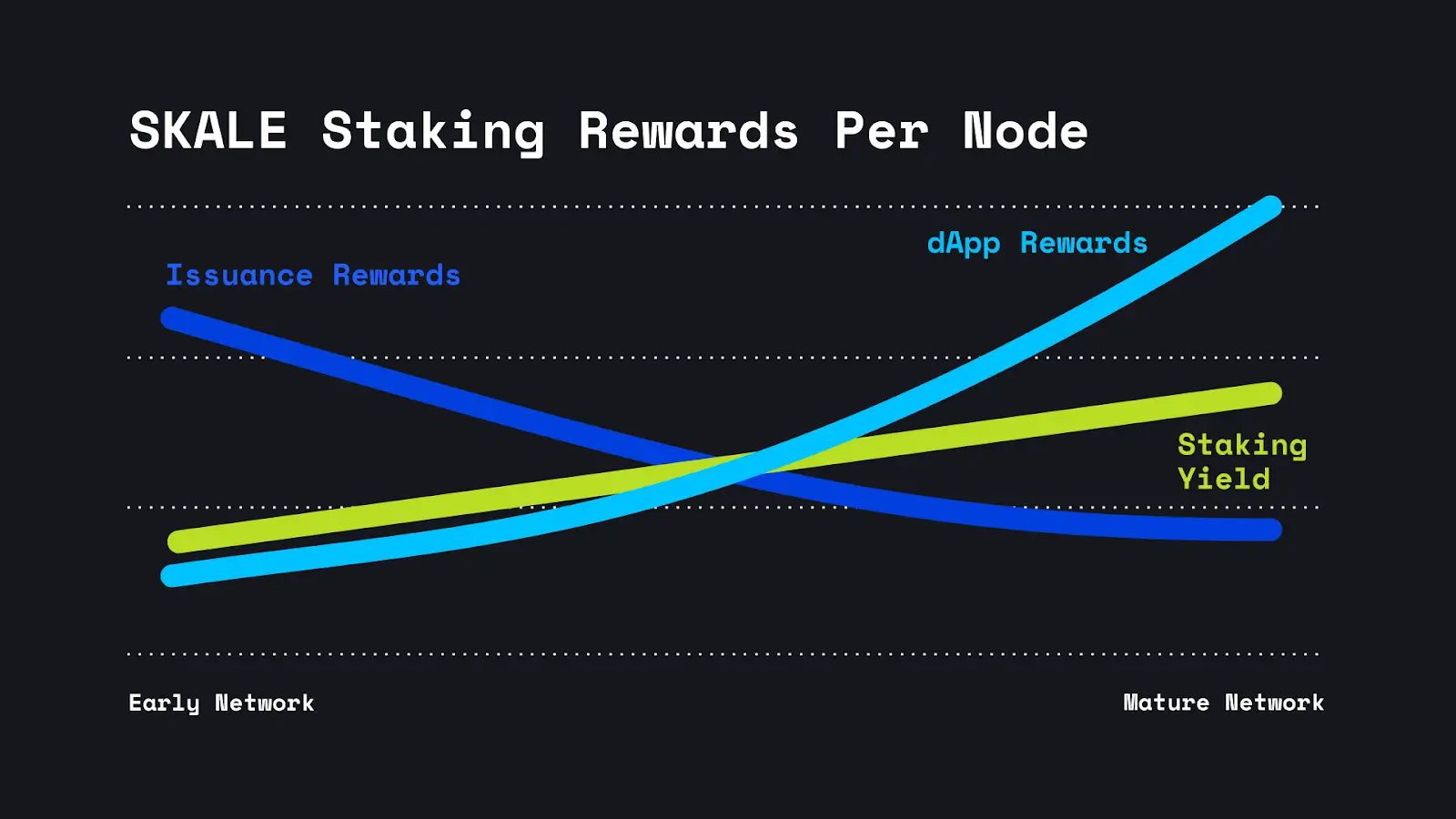
As the network continues to grow and Web3 applications continue to expand across the SKALE Network, total dApp fees are expected to surpass token inflation on a per-node basis and become the primary driver of token rewards. At that point, the intrinsic value of the network will increasingly reflect network utilization and growth.
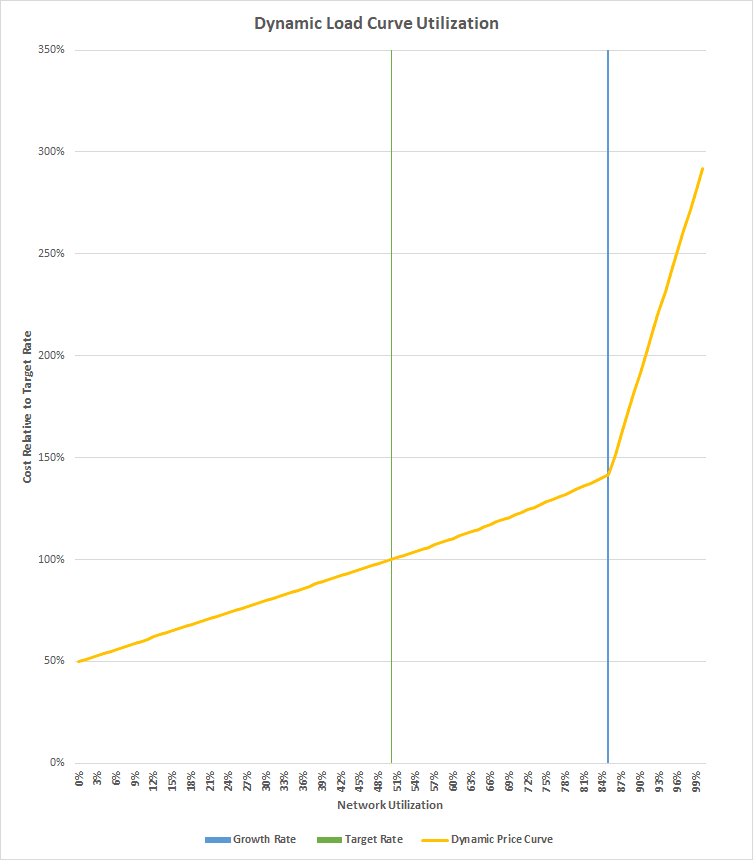
The SKALE Network uses a network load utilization curve at the center of its pricing structure. This curve is designed to balance supply and demand for network capacity, creating a stable and efficient network.
As the network becomes overutilized, the cost of purchasing S-Chain capacity increases. For example, once network utilization exceeds 85%, costs increase sharply, resulting in higher dApp fees entering the network and being distributed as rewards.
In turn, this incentivizes existing validators to operate more nodes and/or encourages new validators to enter the network. This ultimately increases supply, lowers utilization, reduces prices, and stabilizes the network. As utilization increases, this model helps maintain equilibrium throughout the network.
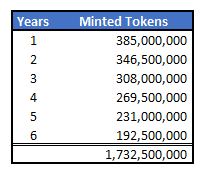
The SKALE Network will issue new tokens (inflation) to support validators. These rewards are weighted more heavily toward the early years, following a declining schedule in which issuance decreases each year over the first six years.
This structure is designed to support validators during the network's early stages. As the network continues to mature and stabilize, token issuance is intended to have a smaller impact in later years as network utilization and growth increase.
SLA thresholds are metrics used to evaluate validator performance, including percentage uptime and response times. If a validator fails to meet SLA requirements during a particular period, as determined by the network's monitoring process, that validator will not be eligible to participate in reward pool distributions. Additional information can be found here.
"Slashing" occurs when a validator engages in malicious behavior, such as double-spending. Such behavior is handled according to processes established through network governance and confirmed by a decentralized group of network participants.
Slashing represents a significant risk to all participants, including delegators, and should be thoroughly understood before participating.
If you are interested in becoming a validator, register here and join the SKALE Discord channels. Through these channels, you will receive the latest information about the product, testnet, mainnet, and data integrations. The Solutions Engineering team will provide support throughout the process.
The network is designed to be permissionless. Future registration and onboarding processes will operate on a self-service basis, eliminating the need to register separately to become a validator.
SKALE, in partnership with ConsenSys, will become the first project to provide public access to its token through Activate, the launch platform from ConsenSys Codefi. The SKALE token will be launched through Activate, providing an opportunity for public token distribution and participation in the decentralized SKALE Network.
SKALE and ConsenSys share the belief that crypto tokens should already have utility within their public decentralized networks when they are issued. To support this principle, Activate introduced a new feature called Proof of Use, which was incorporated into the SKL token launch on the platform.
Proof of Use requires users who claim or purchase tokens during the launch to actively "prove use" of those tokens on the platform before they are permitted to transfer or redeem them for other purposes. In the case of SKL, this means participants must delegate at least 50% of their purchased tokens for at least 60 days before full liquidity becomes available.
This ensures that tokens purchased through Activate are used for their intended purpose following issuance rather than solely for passive speculation. Distributing tokens among stakeholders with aligned incentives helps ensure an effective network launch and establishes the delegation necessary during the initial delegation period.
As described above, delegators are independent individuals who enter into agreements with validators to provide a portion of the total stake required by a node, in exchange for an agreed percentage of the rewards generated through validation.
Each validator may choose either to self-bond—staking a portion of the amount required for each node—or to accept delegations from other token holders. Each validator is free to determine the commission it charges for providing this service.
Likewise, delegators are free to choose which validator they delegate their tokens to. Key factors that delegators may consider when selecting a validator include node performance (SLA), the commission percentage established by the validator, and the validator's reputation. Validators may choose to reject individual delegations or decline to accept delegations altogether.
SKL token holders decide whether they want to commit their SKL tokens to the network. After researching validators and understanding the associated risks, including slashing, delegators can determine how many tokens to delegate and which validator to work with.
Once selected, delegators receive token rewards based on the number of tokens delegated, the commission percentage established by the validator, and the length of the staking period.
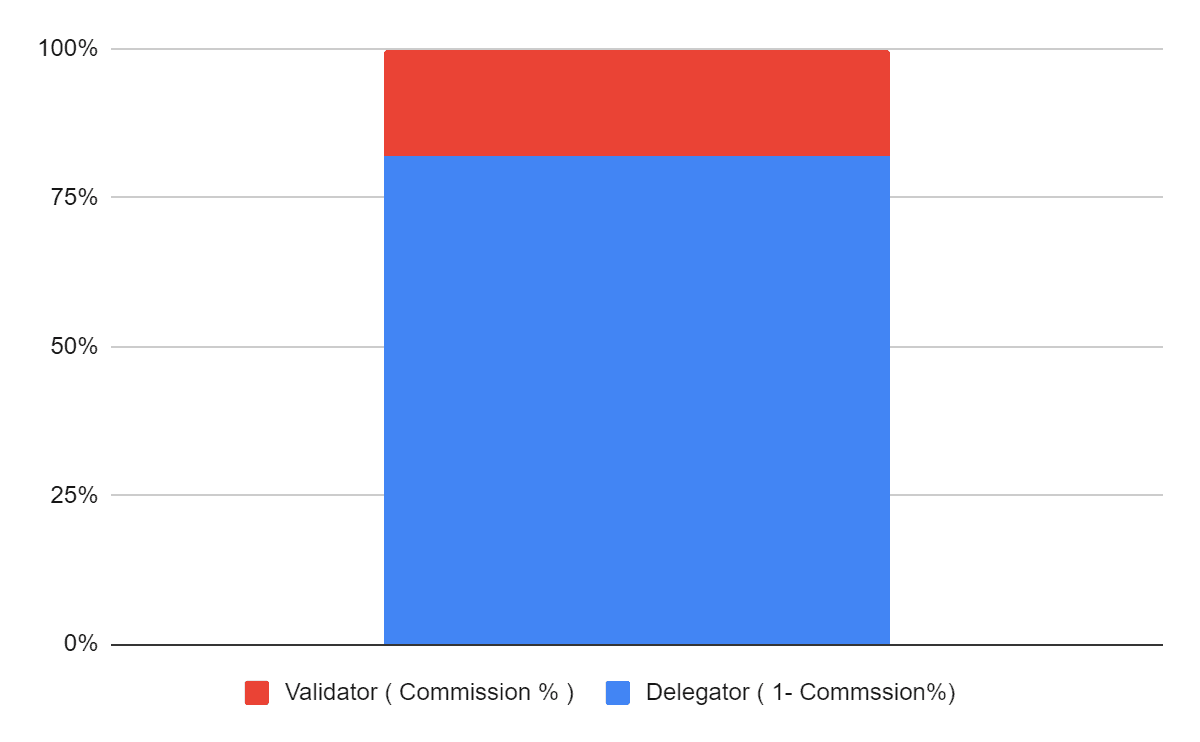
Delegators receive bonuses based on the staking duration they select. The longer tokens are staked, the greater the potential rewards. These rewards are paid and settled at the end of each period. Once a staking duration has been selected, the staked tokens remain locked until that period ends.
Background and Supplementary Information
Token economics are a critical component of nearly every decentralized network. Participants who provide resources and services to a network should be rewarded for their efforts—including both labor and capital—and for the security they provide to the network. Tokens function as a form of currency within the network's economic model, which is designed to reward honest service and discourage malicious behavior.
In Proof-of-Stake systems, network participants known as validators maintain consensus by proposing and voting on blocks of transactions. Nodes operated by validators take turns proposing blocks for other nodes to validate. Other participating nodes review the proposed blocks and vote on their validity. If a sufficient number of validator nodes determine that a block is correct, the block is added to the chain.
Validators (or delegators) stake network assets, typically represented by crypto tokens with sufficient economic value, as collateral to discourage malicious behavior and reward honest service. The network's internal token economy helps maintain the health of the network while rewarding validators for their participation.
If you would like to begin operating a validator node immediately, register here, or continue reading for additional information.
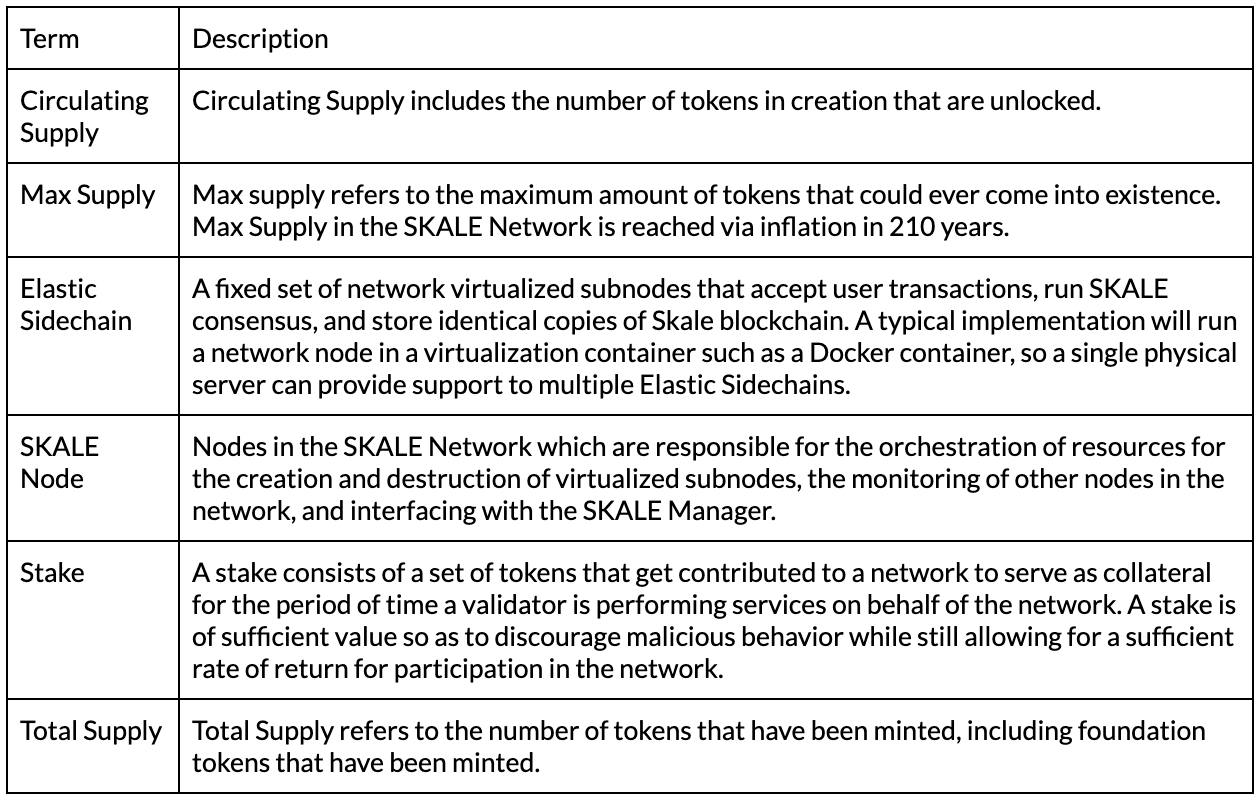
A stake consists of a set of tokens used as collateral within the network while a validator performs services on behalf of the network. The stake must have sufficient value to discourage malicious behavior while also allowing participants to earn an adequate return for contributing to the network.
The SKALE Network is a security and execution layer connected to the Ethereum network that enables developers to build dApps securely, reliably, and efficiently. It is an elastic, decentralized blockchain network capable of supporting thousands of independent blockchains, sidechains, storage chains, and other types of subchains—all connected to the Ethereum public mainnet.
The network forms an execution layer composed of high-performance chains that facilitate transactions hosted on-chain. Through this security and execution layer, the SKALE Network provides full-stack transaction-processing cloud infrastructure and Web3 services.
The SKALE Network provides highly configurable blockchains for individual applications across numerous industries, including DeFi, IoT, gaming, media, and others. SKALE provides effectively unlimited linear scalability—the more validators that join the network, the more blockchains the network can support, ultimately creating a truly decentralized and scalable network.
SKALE combines the best characteristics of blockchain technology and traditional cloud computing to address end-user experience challenges that limit blockchain application development and adoption. It offers frictionless UX, high performance, and cloud-like development agility while maintaining Ethereum's decentralization and security.
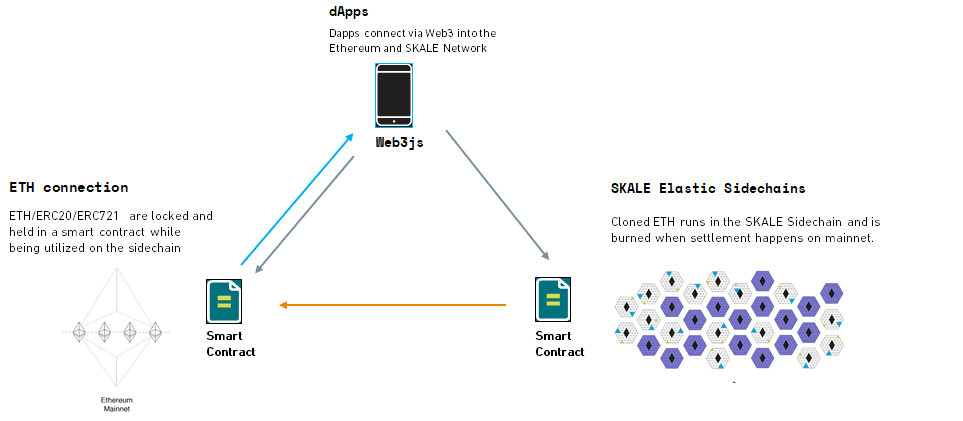
The value of a native utility asset within a network economy is derived solely from the value that the network provides to its users and participants. Staking on the SKALE Network supports a reliable and essential network protocol built with a well-designed economic model and innovative technology intended to serve one billion end users.
SKALE is supported by major backers and leading industry enablers, helping ensure that the team has access to the guidance and funding necessary to build a global network.
The SKALE Network is also supported and operated by leading validators from around the world. Their commitment to the network enabled it to achieve full decentralization at launch. A subset of SKALE validators can be found here.
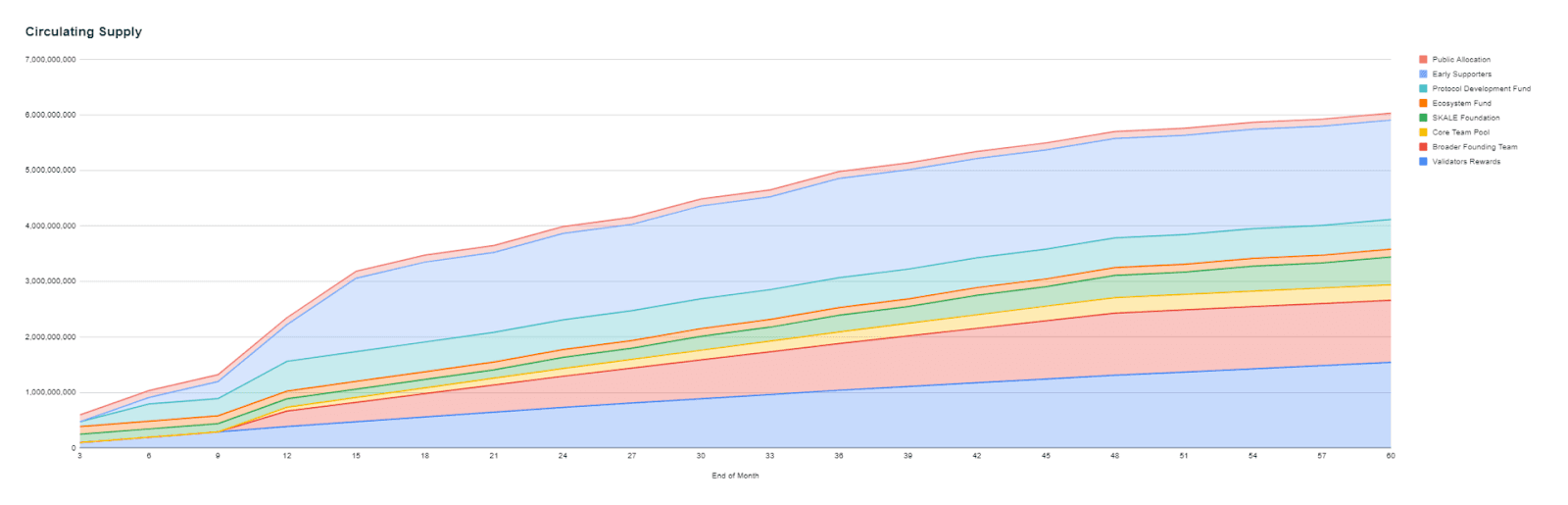
At genesis, the total supply of SKL tokens was 4,140,000,000 SKL. The network has a maximum supply of 7,000,000,000 tokens. Of the maximum supply, 33% (2,310,000,000 SKL) will be minted for network issuance (inflation) over the course of the network's operation.
Of the Foundation's allocation of 700,000,000 tokens, 550,000,000 tokens will be minted in month six as a milestone event. The Foundation allocation will continue according to its full seven-year vesting schedule. Of the remaining 550,000,000 tokens, the first 50,000,000 will unlock at the end of month 24, with additional unlocks occurring every six months until the allocation is fully unlocked.
During the first two months following network issuance, there will be no public circulating supply in order to support Proof of Use. After those first two months—that is, once the Proof of Use phase has been completed—the only publicly circulating tokens will be those purchased through Activate during the network launch and tokens earned through staking rewards.
The circulating supply schedule for the remaining token supply is illustrated in the chart below and in the accompanying interactive chart.
The SKALE Validator FAQ covers the primary questions and concerns validators had at the time of the network launch. It is essential reading, particularly for validators and anyone considering setting up a validator node.
Link: SKALE Validator FAQ
The SKALE Network is an open-source, elastic blockchain network protocol. Our vision is to make it easier and faster to create low-cost, high-performance sidechains capable of running fully stateful smart contracts. Our goal is to provide developers with a fast, highly functional, and efficient experience without sacrificing security or decentralization.
You can follow the SKALE Network on Telegram (@SkaleOfficial), Twitter (@SkaleNetwork), and Discord (www.skale.chat), or visit the SKALE website (www.skale.network). Developer documentation is available through the SKALE Developer Portal (skale.network/docs), and the source code can be found on GitHub (github.com/skalenetwork).